
Real Questions · Straight Answers
Water Damage Restoration: Your Questions Answered
51 real questions — pulled from what people around Ann Arbor actually type into Google — answered the way we'd answer them on the phone: direct first sentence, useful detail after.
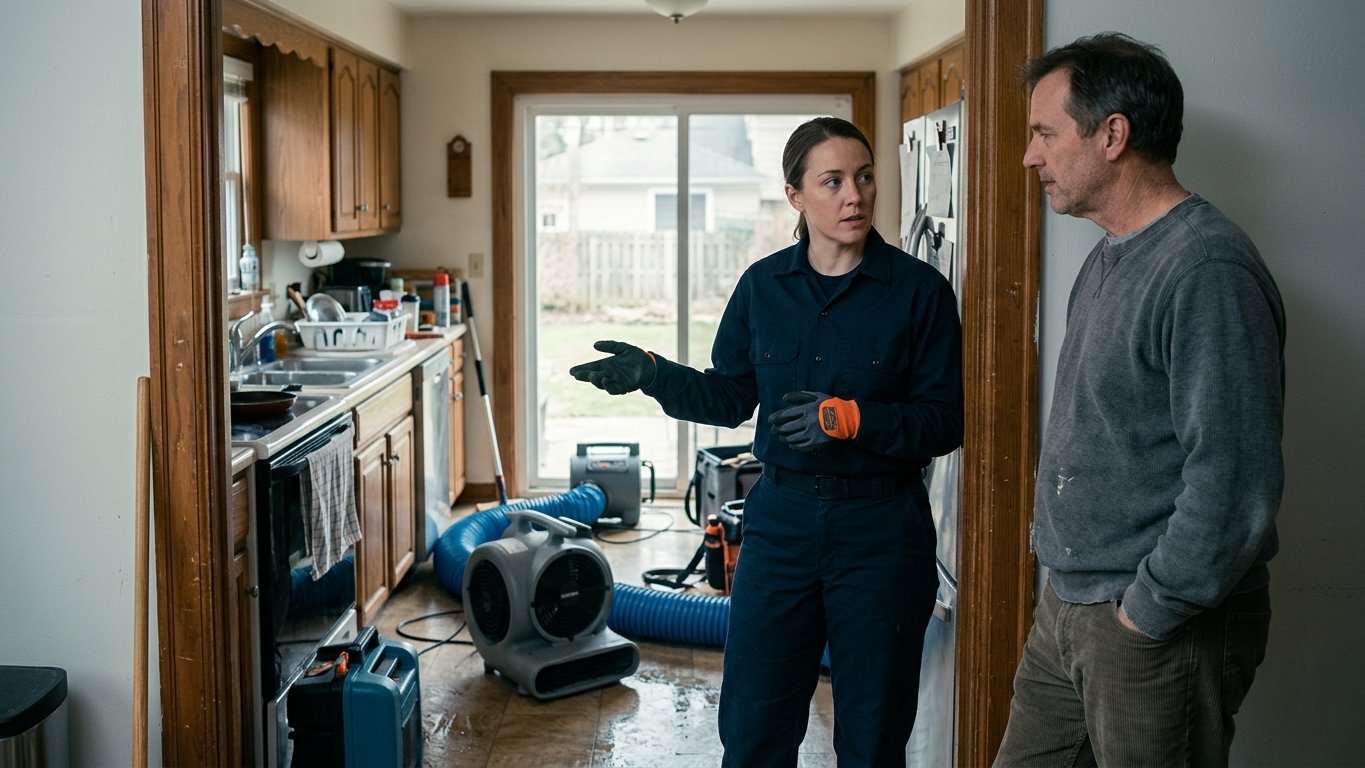
Right After Water Damage
The first hour matters more than any other. These are the questions Ann Arbor homeowners ask us at 2 a.m.
What should I do immediately after water damage?
Stop the water if you safely can — close the main shutoff for plumbing leaks — and keep people and pets away from the wet area. If water is near outlets or the panel, leave the electricity to professionals. Then call a 24/7 restoration line, move what valuables you can, and photograph everything before cleanup starts. Fast documentation makes your insurance claim much smoother.
What should I do when my basement is flooded?
Do not wade into standing water until you know the power to that level is off — water and live circuits are a real electrocution risk. Once it's safe, stop the source if possible, then call for a professional pump-out. Take photos and videos before anything is moved. Avoid running your shop vac for hours; deep or contaminated water needs commercial extraction and drying equipment.
Who should I call for a flooded basement?
Call a water damage restoration company first for extraction and drying — that's the time-critical step. If water is actively coming from a supply line, an emergency plumber stops the source while the restoration crew handles the water. Then notify your insurance company. Our Ann Arbor crew coordinates all three: we extract, dry, and document the loss in the format insurers expect.
Can you live in a house with water damage?
It depends on the water category and the extent. A contained clean-water leak that's drying under equipment is usually livable, if noisy. Sewage-contaminated water, saturated ceilings, active mold growth, or shut-off utilities are reasons to stay elsewhere until cleanup and safety checks are done. A restoration inspection will tell you which situation you're in.
Drying & the Restoration Process
What professional restoration actually involves — and where DIY quietly goes wrong.
Can water damage be restored?
Yes — most water damage is fully restorable when drying starts quickly. Wood framing, concrete, and even many finished surfaces recover if moisture is removed before it soaks in deep. What changes the outcome is time: materials that stay wet for days often need replacement instead of drying, and mold becomes part of the job. That's why restoration companies run 24/7.
What does the water damage restoration process involve?
Five stages: inspection and moisture mapping, water extraction, structural drying with air movers and dehumidifiers, cleaning and sanitizing, then repairs. A crew meters moisture in walls and floors — not just what's visible — and monitors daily until readings return to dry standard. The drying phase is what separates professional restoration from fans-and-hope.
How long does it take for a flooded basement to dry out?
With professional equipment, roughly three to five days is typical — longer for saturated concrete, dense materials, or high humidity, and much longer with household fans alone. The honest answer comes from moisture meters, not the calendar: a basement is dry when readings hit dry standard, and quitting early is how hidden mold problems start.
What's the difference between mitigation, remediation, and restoration?
Mitigation stops the damage from spreading — extraction, tarping, controlled demolition. Remediation removes contamination such as mold or sewage. Restoration rebuilds and returns your home to pre-loss condition. Most real jobs flow through all three, which is why hiring one company for the whole sequence keeps your timeline and your insurance paperwork simpler.
Can I do water damage restoration myself?
Small clean-water spills caught immediately — yes, towels and a fan are fine. Anything that's been wet more than a day, touched drywall or flooring layers, or involves contaminated water is a different job: it needs metered drying and often protective handling. The risk of DIY isn't effort, it's the moisture you can't see, which quietly becomes mold behind walls.
How can I tell if water damage is permanent?
Warped or delaminated flooring, drywall that stays soft, persistent musty odor, and stains that return after painting are signs a material is past drying and needs replacement. A moisture meter settles it: readings that won't come down mean trapped water. Some materials — swollen particle board, delaminated subfloor, saturated insulation — are replaced rather than restored as standard practice.
Mold After Water Damage
Mold is the deadline behind every water loss. Here's how the 24–48 hour window really works.
How fast does mold start after water damage?
Mold can begin growing on damp materials within about 24 to 48 hours — which is why drying can't wait for business hours. The first day is spent by spores settling into wet drywall, carpet pad, and framing; visible growth often follows within days. Starting extraction and dehumidification inside that window is the single best mold-prevention step there is.
Can I remediate mold myself?
Small patches on hard surfaces — roughly under 10 square feet, per EPA guidance — are a reasonable DIY job with detergent, gloves, and ventilation. Larger growth, mold inside walls or HVAC, or anything that followed sewage or long-term leaks calls for professional containment and HEPA filtration, because disturbing it wrong spreads spores through the house.
Should I use bleach to clean up mold?
Usually no. Routine bleach use isn't recommended for mold cleanup — on porous materials like drywall and wood it doesn't reach the roots, and the moisture in the solution can feed regrowth. Fix the water source first, discard porous moldy materials, and clean hard surfaces with detergent. Professional jobs add containment and HEPA air filtration.
What kills mold after a flood?
Moisture control kills mold problems; products alone don't. After a flood the sequence is: remove standing water, discard soaked porous materials like carpet pad and wet drywall, clean hard surfaces, and dry the structure to normal moisture levels. Sprays applied over a still-damp room only delay the regrowth. Drying is the treatment.
What are the first signs of mold sickness?
Mold exposure commonly shows up as allergy-like symptoms: congestion, coughing, wheezing, and eye or skin irritation, often worse at home and better away from it. People with asthma, allergies, or weakened immune systems react most. If symptoms line up with a musty smell or recent water damage, have the moisture problem inspected — and talk to your doctor about the symptoms.
What time of year is worst for mold in Michigan?
Late spring through early fall — warm, humid Michigan months — is peak season for mold growth, especially in basements that hold humidity. Winter brings its own cases from condensation on cold surfaces and from burst-pipe leaks that stay hidden. Practically: any season water sits for more than a day or two is mold season.
Can a house with mold be saved?
Almost always, yes. Mold remediation removes the growth and — the part that matters — corrects the moisture that fed it. Even significant infestations are handled by containing the area, removing contaminated porous materials, cleaning and HEPA-filtering the space, and verifying dryness. Houses get walked away from over the water problem being ignored, not over the mold itself.
Insurance & Claims
Coverage depends on how the water got in. What's typically covered, what isn't, and how to protect your claim.
Does homeowners insurance cover water damage?
Generally yes for sudden, accidental water damage — a burst pipe, a failed appliance line, wind-driven rain through storm damage. Generally no for gradual damage: slow leaks, seepage, or maintenance that was deferred. Overland flooding is excluded from standard policies entirely and needs separate flood insurance. The cause of the water decides the coverage, so document how it happened.
Will insurance cover basement flooding?
It depends on why the basement flooded. A burst pipe is typically covered. Sump-pump failure and sewer backup are usually covered only if you carry a water backup endorsement — a common, inexpensive add-on. Groundwater or overland flood needs a separate flood policy. Check your declarations page for a "water backup" line; many Michigan homeowners are surprised to learn it's optional.
What type of water damage is not covered by insurance?
The usual exclusions: gradual leaks and seepage, damage from deferred maintenance, overland flooding without a flood policy, and sewer or sump backup without that endorsement. Insurers distinguish "sudden and accidental" from "you had time to fix it." That's why fast professional response and dated documentation matter — they establish the loss as sudden.
Will my insurance go up if I file a water damage claim?
It can affect your renewal pricing, and the effect varies by insurer, state, claim size, and your history — there's no universal number. The practical math: compare the documented damage against your deductible. For losses well above the deductible, the claim usually makes sense; for borderline ones, get the restoration scope priced first, then decide with real figures.
What should I avoid saying to my home insurance company?
Don't speculate about the cause, don't volunteer that the problem "may have been going on a while," and don't guess at repair numbers. Stick to documented facts: when you found it, what you saw, and the photos and moisture readings behind them. A restoration company's written scope speaks precisely — let the documentation carry the claim.
Is it worth going through insurance for water damage?
If the documented damage clearly exceeds your deductible — often the case once drywall, flooring, or drying equipment are involved — a claim is usually worth it. For small, contained losses near the deductible, paying out of pocket may protect your claims history. A written restoration estimate gives you the number to make that call before you file.
Does FEMA help with flood cleanup?
Only when the flood is part of a federally declared disaster. In that case, FEMA assistance can help uninsured households with essential cleanup and safety needs — it supplements, not replaces, insurance. For ordinary local flooding in Washtenaw County, your coverage (homeowners, water backup endorsement, or NFIP flood policy) is the funding path.
Cost & Pricing
No two losses price the same — but the pricing method is standard. Here's how the number gets built.
How is water damage restoration priced?
By scope, measured on-site: the water category (clean, gray, or black), how far it spread, which materials got wet, how many days of drying equipment are needed, and what has to be removed versus dried. Reputable companies price from the same industry-standard estimating platforms insurers use, so the scope — not a guess — sets the number. Get it in writing.
How much will insurance pay for water damage?
For a covered claim: the cost to return your home to pre-loss condition, minus your deductible, within policy limits. Payment often arrives in stages, with depreciation held back until repairs are complete. The insurer pays against a documented scope — which is why moisture logs, photos, and a line-item estimate from the restoration company directly shape the payout.
Why do water damage estimates vary so much?
Because the visible puddle isn't the job — the moisture in walls, flooring layers, and framing is. Two estimates differ when one is priced from a walkthrough glance and the other from moisture readings. Category of water, drying-equipment days, and demolition scope drive cost. Insist on an estimate built from metered readings, and the range narrows fast.
Sewage Backups
Category 3 water has its own rules. What safe cleanup looks like.
How do you clean up after a sewer backup?
Treat everything the water touched as contaminated. Professionals work in protective equipment: extract the black water, remove contaminated porous materials, disinfect every hard surface, then dry and verify the structure. Skip the shop-vac-and-open-windows approach — Category 3 water carries bacteria and viruses, and aerosolizing it makes exposure worse.
Can carpet be cleaned after a sewer backup?
Carpet and pad that absorbed sewage are removed and discarded, not cleaned — that's the standard practice for Category 3 water, and it's about safety, not cost. Contamination bonds to porous materials no shampooing can fully remove. Hard flooring underneath can usually be disinfected and saved. Your insurer expects the carpet line item; it's normal.
Storm Damage
When Michigan weather opens the building envelope, minutes count.
What is storm damage restoration?
The emergency response after wind and rain breach a building: tarping and board-up to stop more water getting in, extraction of what already did, structural drying, and coordination of the rebuild. It's mitigation first — every hour a roof breach stays open adds wet insulation, ceilings, and walls to the claim.
What should I do if my house is damaged by a storm?
Safety first: stay clear of downed lines, damaged roof sections, and rooms with sagging ceilings. Then prevent further damage — that's a policy obligation — by getting the breach tarped fast. Photograph everything before and after temporary repairs, notify your insurer, and get drying started on any wet interior within the first day.
Who cleans up after a storm?
Different trades split it: tree services clear fallen timber, roofers handle the permanent roof repair, and a restoration company does the emergency tarping, water extraction, and structural drying in between. The restoration crew is usually the first call because stopping active water intrusion protects everything the other trades will later rebuild.
Fire & Smoke Damage
The fire is out — now soot, smoke odor, and firefighting water are the job. What homeowners ask next.
Can you just paint over smoke damage?
Not directly — soot bleeds through ordinary paint, and trapped odor comes back with humidity. The working order is: clean the soot off the surface, neutralize the odor, then prime with a stain-blocking sealer before any paint goes on. Painting first locks the problem in and doubles the work later. It's the most common DIY fire-cleanup mistake we see.
Does homeowners insurance cover smoke damage?
Fire and smoke are core perils on standard homeowners policies, so smoke damage — including smoke from a nearby fire — is generally covered. Documentation still decides how smoothly the claim goes: photos before cleanup, an itemized scope, and clear cause notes. We document as we work and deal directly with your adjuster, the same way we do on water claims.
Is there a standard for professional fire and smoke restoration?
Yes — the IICRC publishes the S700 standard for professional fire and smoke damage restoration, the fire-side counterpart to its S500 water standard. It defines how smoke residues are assessed, cleaned, and verified rather than just wiped and hoped. As an IICRC Certified Firm, that standards-based approach is how our crews are trained to work.
Why is there water damage after a fire?
Because putting a fire out is a water event. Fire hoses can push hundreds of gallons into a structure in minutes, so a 'fire job' is usually a fire, smoke, AND water job — soaked drywall, wet insulation, saturated carpet. That's why a company that does both matters: one crew handles soot and smoke while the drying equipment runs.
How long does smoke smell last in a house?
Left untreated, months to years — smoke particles settle into carpet, fabrics, and HVAC ducts and re-release every time humidity rises. Treated properly, the source residues are removed and remaining odor is neutralized rather than masked, which is why professional treatment holds where air fresheners fail. The sooner soot is cleaned, the less it etches and the less odor sets.
Structural Drying
Drying is measured, not guessed. How the meters, math, and dry standard actually work.
What is applied structural drying?
The controlled, measured drying of a building — air movers, commercial dehumidifiers, and daily moisture readings that bring framing, subfloors, and drywall back to dry standard instead of guessing. The IICRC trains it as its own discipline (ASD) for a reason: drying too little grows mold, and drying blind tears out material that could have been saved.
How long does it take for water to cause structural damage?
Damage starts within hours — drywall wicks water upward, particle board swells, and finishes delaminate the first day. Mold can join within 24–48 hours. Structural framing tolerates more, but every day wet lumber sits, the odds of warping and rot climb. That's the honest reason restoration runs 24/7: the clock decides what's salvageable.
How do you know if moisture is behind drywall?
Meters, not eyes. A moisture meter reads through the surface, and a thermal camera flags cool evaporation patterns worth probing. Signs you can spot yourself: bubbling paint, swelling baseboard, a musty smell, or a wall that feels cool days after a leak. If a wall took water and nobody metered it, assume it's still wet until proven dry.
Can't I just run fans and a dehumidifier myself?
Household fans dry surfaces; they rarely dry structure. Water that reached carpet pad, subfloor, or wall cavities needs directed airflow, commercial dehumidification, and readings to confirm it actually left. The failure mode of DIY drying isn't effort — it's declaring victory early and finding mold or warping weeks later.
What does 'dry standard' mean?
It means wet materials have been brought back to the moisture level of equivalent dry materials in the same building — verified with readings, not judged by touch. We log readings daily and hand you the final log at the end. It's the difference between 'seems dry' and documented dry, and your insurance adjuster knows the difference too.
Carpet Cleaning & Repair
When carpet can be cleaned, when it can be repaired, and when it genuinely has to go.
Is it worth getting carpets professionally cleaned?
For carpet you plan to keep, yes — professional hot-water extraction pulls out ground-in grit, allergens, and residues that rental machines mostly redistribute. The difference is water temperature, vacuum power, and technique: truck-mounted equipment rinses soil out instead of soaking it in. Clean carpet also lasts longer, because grit is what wears down pile.
Is it better to steam or shampoo carpet?
Hot-water extraction — what most people call steam cleaning — is the method carpet makers generally recommend, because it rinses soil out rather than working detergent in. Shampooing can leave sticky residue that attracts dirt faster. We run truck-mounted hot-water extraction, the same class of equipment we use on water-restoration jobs.
Can you repair just a patch of carpet?
Yes — patching is the standard fix for burns, permanent stains, and pet damage. A matching donor piece (from a closet or a leftover remnant) is cut in and seamed so it blends into the surrounding pile. It costs far less than replacement and buys years of life. The limiting factor is donor carpet, so keep remnants from the original install.
Why is my carpet rippling, and can it be fixed?
Ripples mean the carpet has relaxed off its tack strips — age, humidity, dragged furniture, or an install that was never power-stretched. The fix is re-stretching: pulling the carpet taut with a power stretcher and re-securing it. Left alone, ripples turn into wear lines and trip hazards; caught early, it's a quick repair instead of a replacement.
Can carpet be saved after water damage?
Often, if the water was clean and drying starts fast: the carpet is extracted, dried properly (the pad usually gets replaced), then re-stretched and reinstalled. Sewage-contaminated carpet is the exception — Category 3 losses mean carpet and pad are discarded for safety. Doing restoration and carpet work under one roof is exactly what makes the save possible.
Odor Control
Smells have sources. Masking fails; source removal doesn't.
How do you permanently remove odors from a house?
Find and remove the source — that's the whole game. Sprays and plug-ins mask; permanent removal means extracting or cleaning what actually holds the smell (soot residue, pet-soaked pad, sewage-touched material, mold growth), then treating the surfaces that absorbed it. If a smell keeps coming back, the source is still there. That's what we trace first.
What's the hardest smell to get rid of in a house?
Smoke and pet urine compete for the title. Both penetrate porous materials — carpet pad, drywall, ductwork — and re-release with humidity, which is why surface cleaning alone fails. Both are beatable, but treatment has to reach where the odor lives: the material gets cleaned, sealed, or removed, not just the air freshened.
What should I do about a musty smell in my basement?
Treat it as a moisture alarm, not a smell problem. Musty means microbial activity somewhere damp — seepage, a slow leak, or humidity feeding mold growth. Air fresheners won't fix the source, and a dehumidifier alone only slows it down. Get the moisture found and fixed; the smell leaves with it.
Who do I call for a strange smell in my house?
Depends on the smell. Rotten eggs or gas: leave the house and call your gas utility first — that's a safety issue, not a cleaning issue. Sewage: a restoration company, since it often signals a backup or a dried-out drain trap. Musty, smoky, or animal odors: that's odor-control work — we trace the source and treat it.
Question not here?
Ask it live — the 24/7 line is answered by the crew, not a call center. Or start with the service page that matches your situation: our water damage restoration overview for Ann Arbor routes you to the right one.
Reading FAQs at 1 a.m. with wet carpet?
That's exactly who this page is for — and exactly why the phone line is open. Call now, read later.