
Drying a basement isn't one job — it's four in a row, and the order is the whole trick. Here's the professional sequence, including where DIY honestly stops making sense.
Step 1: Safety, then stop the inflow
Power to the flooded level confirmed off before anyone's feet get wet — non-negotiable. Then address the source: shutoff valve for plumbing, sump repair or backup pump for groundwater, and for seepage, wait until inflow actually stops. You cannot dry a basement that's still filling.
Step 2: Get the standing water out fast
A submersible pump handles depth; a wet/dry vacuum handles the last inch — for small, clean-water events. What consumer gear can't do is pull water out of carpet pad and concrete pores, which is why professional truck-mounted extraction exists. The faster this step goes, the less of step three you need.
Step 3: Triage the materials honestly
- Carpet pad: soaked pad is a sponge you cannot dry — it comes out, even when the carpet above survives.
- Drywall: wicks water upward from the floor. Small clean-water events may dry with aggressive airflow; visible swelling or a wick line that keeps climbing means cutting out the wet band.
- Boxes, fabric, particle-board furniture: the hard-truth pile. Swollen particle board doesn't come back.
- Concrete and sealed hard floors: survivors — clean, then dry.
Step 4: Air movement + dehumidification, together
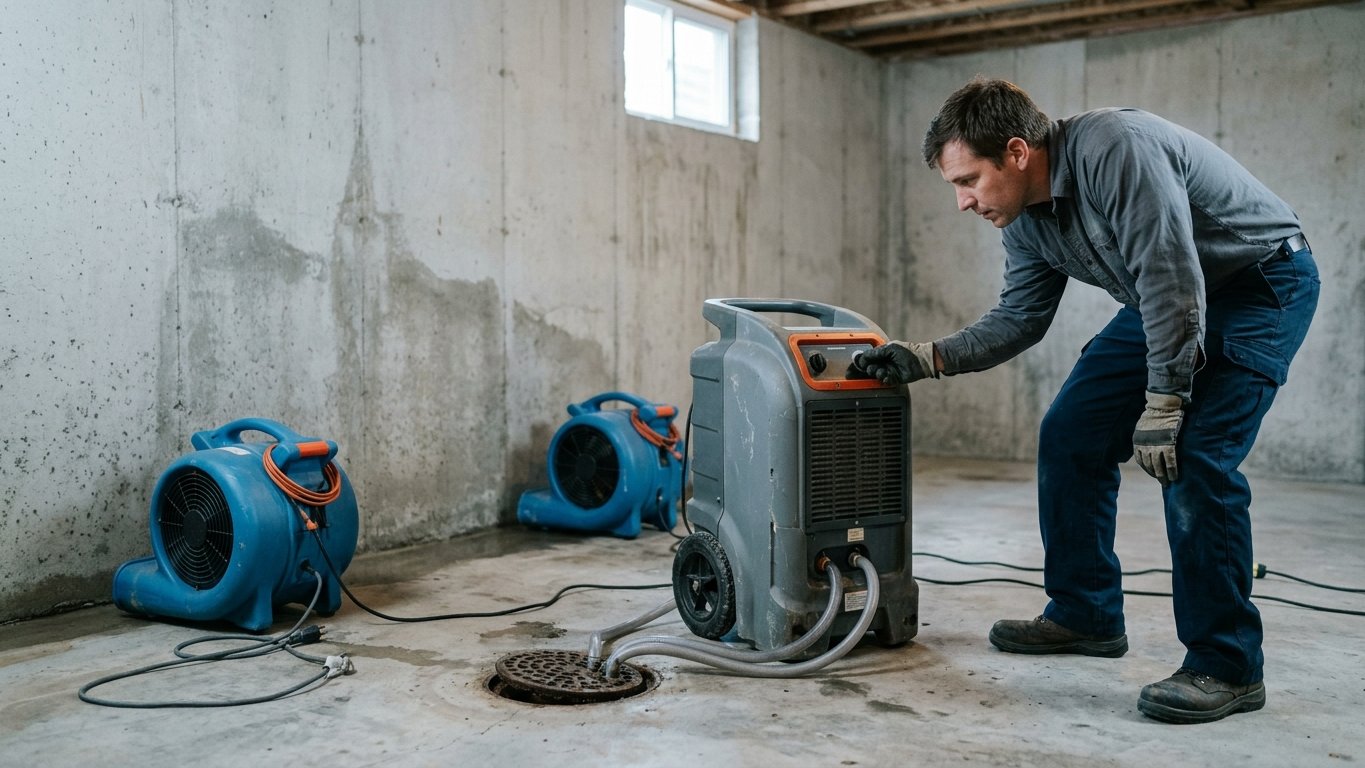
Fans alone move moisture into the air; without a dehumidifier pulling it back out, a closed basement just becomes a humid basement. Run both: air movers angled across (not into) wet surfaces, dehumidifier emptied or hose-drained continuously, door closed so you're drying the basement and not the whole county. Expect days, not hours — with professional equipment, a typical basement runs three to five days to reach dry standard.
The step everyone skips: verify with numbers
"Feels dry" is how basements grow mold behind new paneling. Moisture meters on the slab, the base of the walls, and any framing tell you when drying is actually done. The stakes of quitting early are spelled out in the EPA's mold cleanup guidance: mold needs only a day or two on damp material to get started.
The honest DIY cutoff
DIY is reasonable when the water was clean, shallow, caught the same day, and the basement is unfinished. Call professionals when water sat overnight or longer, touched drywall or a finished space, involved a drain or sewage, or when you simply can't verify dryness with instruments. The cost of calling late is almost always higher than the cost of calling early.
This guide supports our service page: Basement flooding cleanup in Ann Arbor — where the professional version of this work is explained end to end.